By Vera Kurczewski, Columbia College, Class of 2029
At certain points, during the early 20th century, Columbia University’s relationship with its Jewish students was complicated by the college’s wariness of a Jewish presence on campus. Some administrative members unfotunately succumbed to the perception that “there were already enough Jews at Columbia” (See McCaughey, Stand Columbia, 258). Restrictive admission policies were implemented to prevent an ‘excessive’ number of Jewish applicants from entering the college. Additionally, an influential antisemitic fraternity song underscored Columbia’s view of the school’s Jewish quota;
“Oh Harvard’s run by millionaires
And Yale is run by Booze
Cornell is run by Farmer’s sons,
Columbia’s run by Jews.”
(See “Columbia For Jews? The Untold Story of Seth Low Junior College,” The Current)
Jewish students were subjected to unchecked prejudice, indicating administrative indifference towards Jewish ‘issues’.
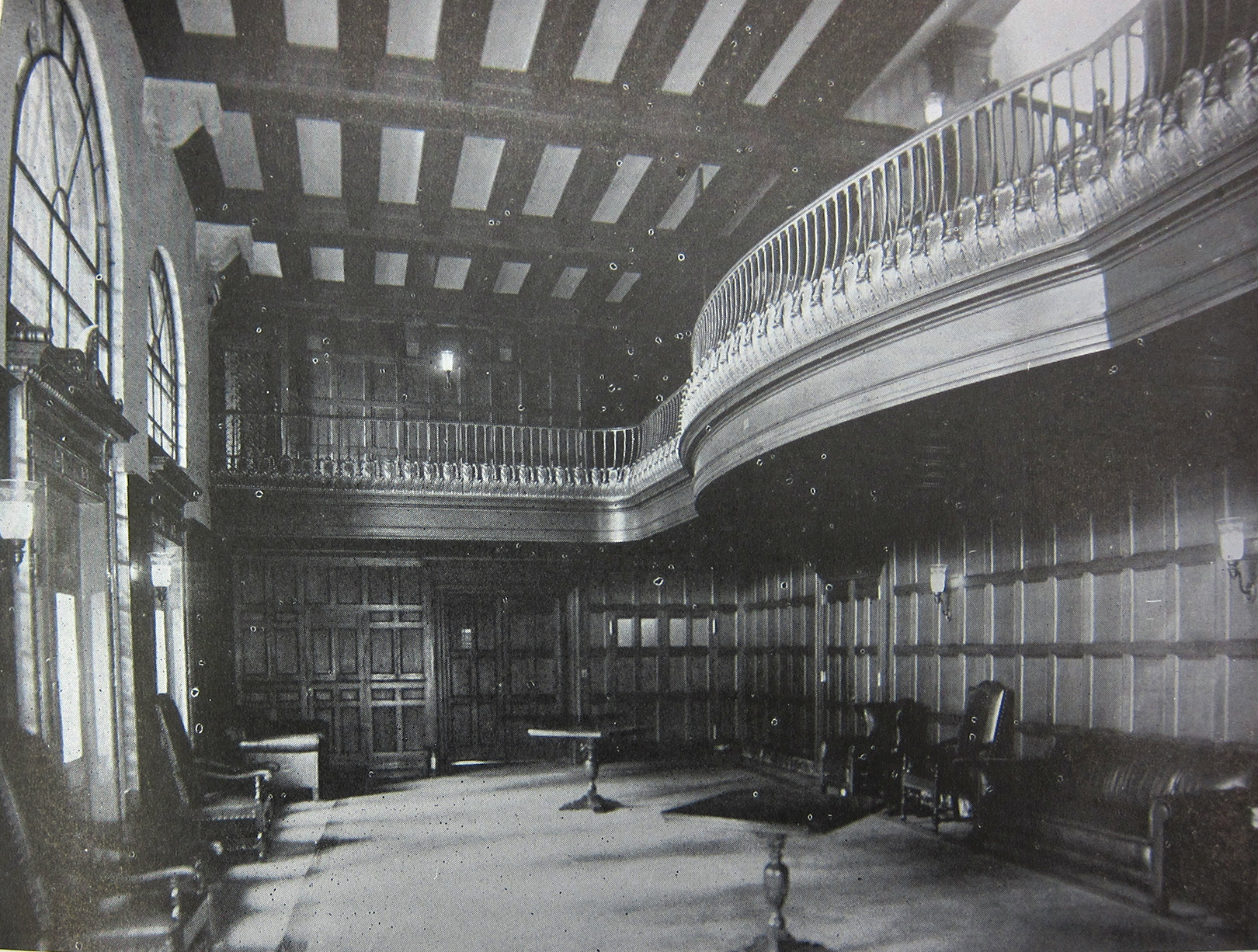
In the latter months of 1933, Nazi influence found its way to New York’s Morningside campus. Pro-Hitler events took place, such as a speech by the former Chancellor of the German Reich and an alleged Nazi affiliation with Columbia’s Deutsches Haus.
In 1934, Rabbi Baruch Braunstein, counselor to Jewish students and founder of Columbia’s Judaica clubs planned a Jewish Purim dance to raise funds for Jewish students abroad as an “American student effort to ameliorate the plight of German youths exiled by the Nazi regime.” Unfortunately, at the planned Purim celebration on March 3rd of 1934, “tangible evidence of…Nazi rowdyism” came to fore. The dance included groups of the Columbia Jewish Students’ Society, the Barnard Menorah Society, and others. While celebrating, the dance was thrown into disarray by loud electrical explosions and the throwing of rotten eggs. Additionally, in an account from the Jewish Press, “At the height of the dance, a number of electric bulbs were tossed from the balcony onto the dance floor.” Signs exhibiting swastikas and reading “Hiel Hitler” [sic], appeared over the balcony of John Jay’s main lounge.
Arnold Milton Beichman, class of 1934 and Spectator writer, described the event’s horrors. He recounted in Kings College Today that “as soon as the lights went low, a group of fraternity members crept onto the balcony over the dance floor and threw down handfuls of Swastikas, shouting ‘Down with the Jews.’” Hundreds of students witnessed the event.
The Columbia Daily Spectator‘s written accounts of the Nazi-inspired hostility, however, minimized the event’s impact. The article (linked above) was titled “Swastika, Hurled From Balcony, Disrupts Jewish Society Dance.” It did not mention the violence of the offense, nor did it name the orchestrators of the so-called ‘momentary confusion.’ The Daily Spectator‘s congruent minimization of the attack demonstrated a chilling normalization of the school’s passivity at the time.
Robert Jay Burton, of the 1935 class of Seth Low Junior College, commented on these events as well. In the College’s newspaper, The Scop, Burton characterized the event as “Practical jokers on the Columbia campus already are pasting mysterious swastikas in prominent places.’” Burton’s interpretation pokes fun, implying that the violence was rather comical than something of true concern; however there was no evidence of his attendance at the event. But sardonic humor was par for the course at The Scop. After all, at the Seth Low Junior College, there “talks of introducing Greek life to the young school, though these plans never came to fruition,” and it was Robert Burton, “head of the Fraternity-Independent group,” at SLJC who downplayed the assault. As the spring semester progressed, Burton acknowledged the impact of Nazi Germany but repurposed his ideas from 1933, explaining that the mass mobilized violence perpetrated by Nazi Germany and the presence of nationalist indoctrination had not been evident in the United States.
After the dance, swastikas spread further across campus, appearing on Hamilton Hall and under the doors of faculty and Spectator offices. As further tangible forms of National Socialist propaganda reappeared, Acting Dean Nicholas McKnight finally opened an investigation. In an article from the Columbia Daily Spectator; “McKnight Launches Investigation As Five More Swastikas Appear,” McKnight explained that, “The College objects most vigorously to the recent occurrence involving displays of the Nazi symbol,” and noted, “It is a vicious sort of joke.” Notwithstanding McKnight’s acknowledgement, the Purim attack was regarded as a starting point for an investigation of antisemitism on campus. Frederick J. W. Heuser, professor of German and head of the Deutsches Haus, is also quoted within the same article. Heuser noted that he “emphatically disavowed any connection between the Deutsches Haus and the appearance of the Nazi emblems. He described it as ‘a lark and practical joke.’” McKnight’s investigation resulted in an antiwar conference, and an approved budget ironically allocated for dances held in John Jay Hall.
On May 8th, two months after the Purim dance, Rabbi Baruch Braunstein resigned. The Columbia Spectator headline read: “Braunstein Quits Office, Finds Attitude Forced by Anti-Semitism.” Braunstein, a celebrated Jewish advisor and academic, had persistently discussed issues and celebrated Jewish life throughout his five years at Columbia University. The Daily Spectator cited the reason for his quitting as a “return to the active ministry.” Even so, as the facilitator of the Purim celebration, his views as described in the Jewish Daily Bulletin expressed shock that, “… students [were] at the bottom of the escapade” In discussions with Arnord Beichman, Rabbi Braunstein himself feared the publication of the attack from the Spectator would motivate a victim narrative for students. The article citing his resignation outlined that “Jews generally have come to feel the inevitability of being a Jew.”
Furthermore, alluding towards the perpetrators of the Purim event, it is noted that, “Nearly as high a percentage of the conferences he has held concern extra-curricular and fraternity problems.” After the violence from the Purim dance and Rabbi Braunstein’s resignation, Jewish life was relegated to private spaces in the final months of the semester.